
アイキャッチはNASA提供
(Wikipediaより)ロビン・キャヌプ (Robin Canup) によるシミュレーション
2005年に発表されたロビン・キャヌプ (Robin Canup) によるシミュレーションによると、カロンは地球の月と同様に約45億年前に大衝突によって誕生したと考えられている(ジャイアント・インパクト説を参照)。
シミュレーションによると、冥王星の場合には、直径が1,600kmから2,000kmほどある他の太陽系外縁天体が、1km/sほどで衝突したとされた。キャヌプは、このような衛星形成の過程は初期の太陽系では一般的だった可能性があると推測している[4]。
エンディ予想
軌道の起源について考えてみると、まずは円軌道が基本です。その後衝突により楕円軌道になるのは、楕円軌道のところで述べた。軌道が決まる事象は他にないかと考えてみたら、爆発による軌道というのがあるのではないかと予想する。確かに、冥王星には、クジラのような衝突の痕跡があるが、これによってカロンなどができたのは考えにくい。衝突したとすれば、もっと複雑な軌道をしているはずです。二重星のような正確な動きをすのは難しい。確率が低いです。
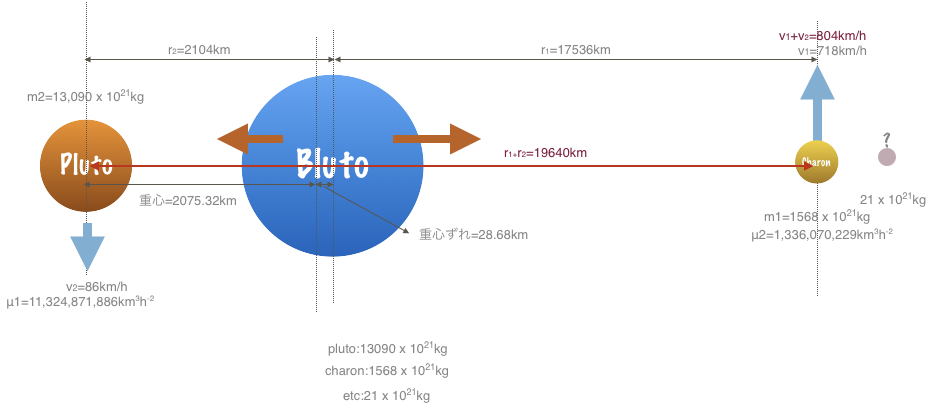
爆発による軌道は、質量の軽いものが遠くへ、質量の重いものが近くへ、それぞれ反対方向に飛べば、バランスが取れます。実際は、うまく2つに別れることはないが、細く別れても、質量の逆数の比で飛んでいくと考えられる。
そこで、プルート(冥王星)とカロンについては、当初ブルート(仮につけてみた)が爆発して、プルートとカロンと細かい天体に別れて、プルートが2,104kmカロンが17,536km飛んで二重星のように回っていると考えられる。
原始冥王星(BLUTE)の回りをステュクスとケルベロスが回っていた。その後原始冥王星が爆発して冥王星とカロンとニクスとヒドラができた。と予想する、証拠としては、ステュクスとケルベロスは、冥王星からの軌道半径の動きが、±2000kmほどある。ということは、元の中心が2000kmずれれば、円軌道になる。そこに原始冥王星(BLUTE)があったとすれば、ステュクスとケルベロスの軌道が納得できます。今の冥王星とカロンとニクスとヒドラは、原始冥王星(BLUTE)から、爆発で生まれたと解釈すれば、二重星のような動きも、前述のような仕組みで納得でる。
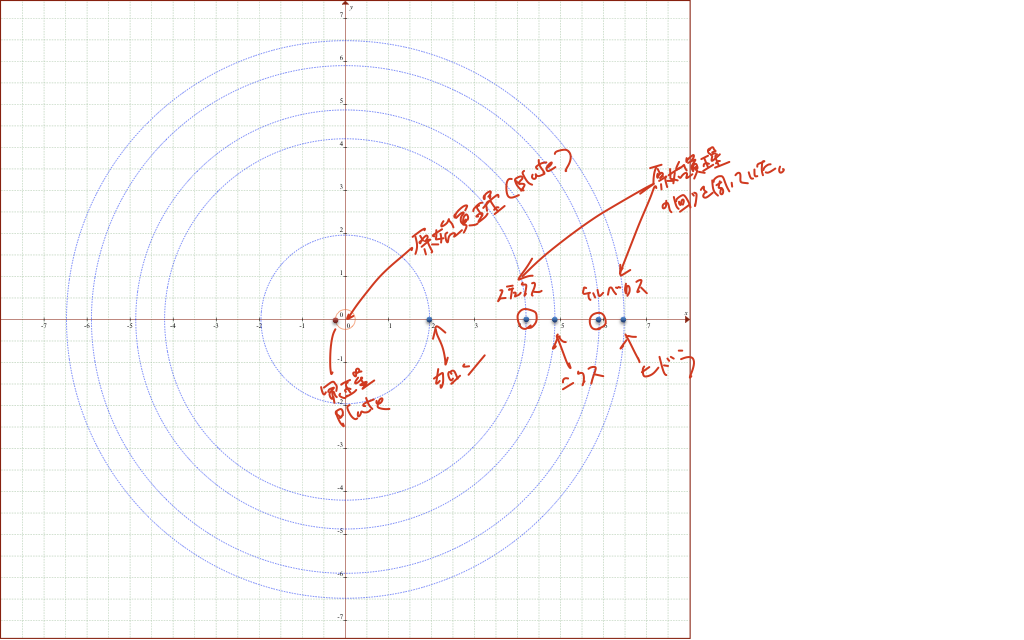
軌道半長径は、冥王星からの距離です。
結論
ブルートが太陽の回りを周っていて、衛星として、ステュクとケルベロスがその回りを周っていた。そして、その後ブルートが爆発して、冥王星とカロンとニクスとヒドラに分裂した。というのがエンディ予想です。
| 名前 | 直径 (km) | 質量 (kg) | 軌道傾斜角 (度)※ | 離心率 | 軌道半長径 (km) | 公転周期(日) | 発見年 | |
|---|---|---|---|---|---|---|---|---|
| I | カロン S/1978 P 1 | 1,212.0 ± 3.0 | 1.529 ×10²¹ | 0.0 | 0.0 | 19,571 ± 4 | 6.387 | 1978 |
| V | ステュクス S/2012 P 1 | 10 – 25 | ? | ~0? | ~0? | 42,000 ± 2,000 | 20.2 ± 0.1 | 2012 |
| II | ニクス S/2005 P 2 | 40? | <5 ×10¹⁸ | 0.10 ± 0.33 | 0.002 ± 0.002 | 48,675 ± 21 | 24.856 ± 0.001 | 2005 |
| IV | ケルベロス S/2011 P 1 | 13 – 34 or 14 – 40 | ? | ~0? | ~0? | 59,000 ± 2,000 | 32.1 ± 0.3 | 2011 |
| III | ヒドラ S/2005 P 1 | 45? | <5 ×10¹⁸ | 0.25 ± 0.11 | 0.005 ± 0.001 | 64,780 ± 88 | 38.207 ± 0.001 | 2005 |
NEW SATELLITE OF (134340) PLUTO: S/2011 (134340) 1
M. R. Showalter, SETI Institute; and D. P. Hamilton, University of
Maryland — on behalf of a team that includes S. A. Stern (Southwest
Research Institute), H. A. Weaver (Applied Physics Laboratory, Johns
Hopkins University), and A. J. Steffl and L. A. Young (Southwest Research
Institute)) — report the discovery of a new satellite of Pluto. The object,
provisionally designated S/2011 (134340) 1, was detected in five separate
sets of images taken by the Hubble Space Telescope WFC3/UVIS: two sets on
2011 June 28.6 UT, two on July 3.4, and one on July 18.92. The body is
visible in individual 8-minute exposures, and S/N > 5 when the five images
of each set are co-added. On June 28, the satellite was 2″.48 from the center
of Pluto in p.a. 335 deg; on July 3, it was 2″.01 from Pluto at p.a. 27 deg;
on July 18, it was 2″.035 from Pluto at p.a. 198.1 degrees. The satellite’s
magnitude is V = 26.1 +/- 0.3, making the object about 10 percent as bright
as Pluto II (Nix). The diameter depends on the assumed geometric albedo:
14 km if p_v = 0.35, or 40 km if p_v = 0.04. The motion is consistent with a
body traveling on a circular, equatorial orbit. The inferred mean motion is
11.2 +/- 0.1 degrees per day (P = 32.1 +/- 0.3 days), and the projected radial
distance from Pluto is 59000 +/- 2000 km, placing the satellite between the
orbits of Pluto II (Nix) and III (Hydra).
Subsequent to the discovery of S/2011 (134340) 1 by Showalter et al.,A. J. Steffl and S. A. Stern, Southwest Research Institute (SwRI); M. R.
Showalter, SETI Institute; H. A. Weaver, Applied Physics Laboratory, Johns
Hopkins University; D. P. Hamilton, University of Maryland; and L. A. Young,
SwRI, report the probable detection of S/2011 (134340) 1 in archival Hubble
Space Telescope ACS/HRC images taken on 2006 Feb. 15. The object has a S/N
of 2.5-3.0 in each of four images and V = 26.0 +/- 0.3. It appears at a
distance of 2″.26 from Pluto at position angle 1.7 deg on 2006 Feb 15.63 UT
and at 2″.26 from Pluto in position angle 2.7 deg on 2006 Feb 15.69.
※……カロンの軌道面を0度とした場合